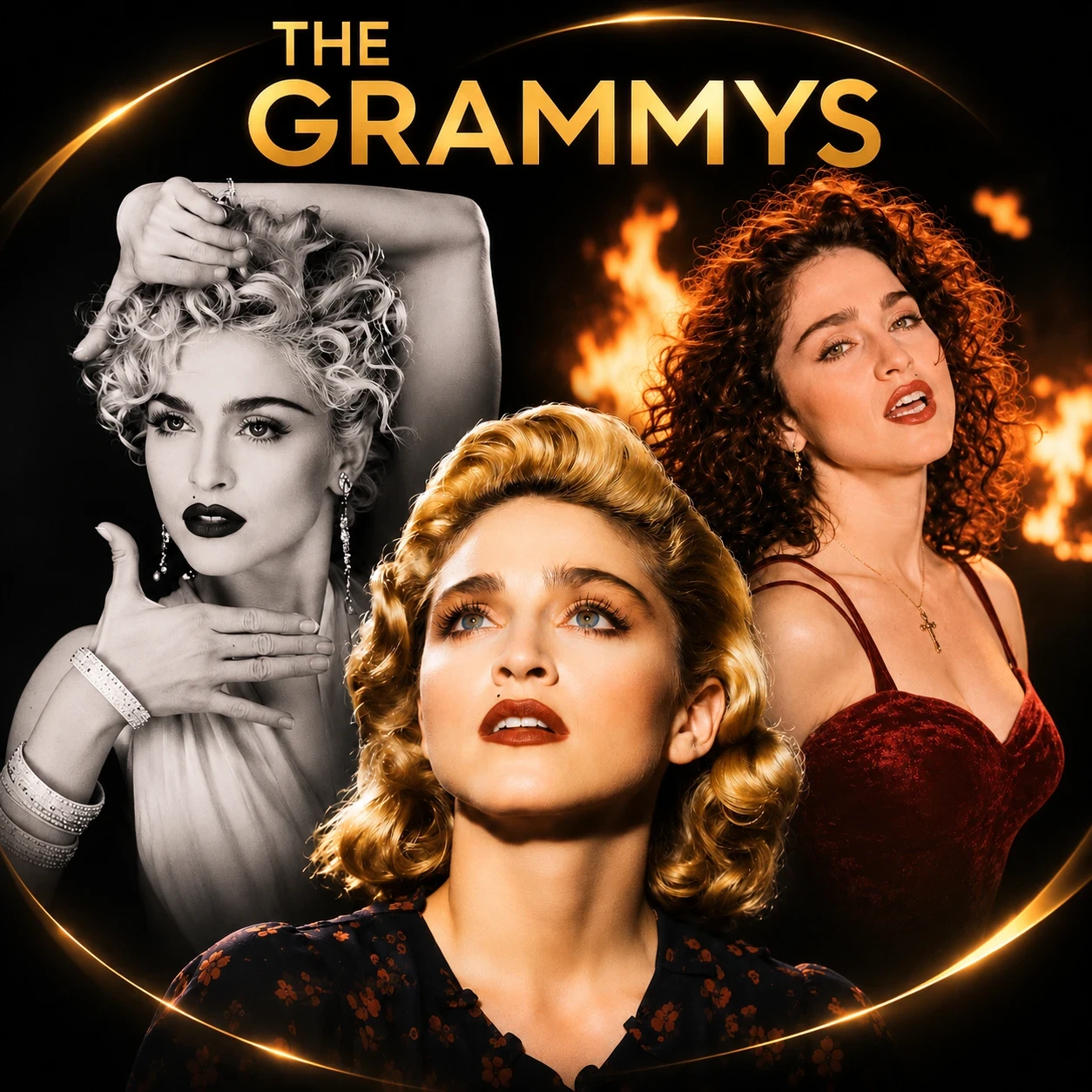
In 1990, Madonna released “Vogue”, a record that would become one of the defining songs of her career and one of the most recognisable dance recordings in popular music history. Written and produced with Shep Pettibone, it brought elements of New York’s underground ballroom culture to an international audience, while transforming the sound of house music into an irresistible mainstream pop record.
It reached number 1 in the United States, inspired one of the most celebrated music videos of its generation and established a cultural legacy that continues to be discussed and studied decades later.
At the 1991 Grammy Awards, it received precisely zero nominations. Not for Record of the Year. Not for Song of the Year. Not even for Best Female Pop Vocal Performance.
Tomorrow, 7:45 am ET (13:45 CET): live the Grammy nominations with the community on the DrownedMadonna home page.
It is tempting to dismiss this as another example of the Grammys getting things wrong. Every award has its omissions, and musical excellence is hardly something that can be measured objectively. But in Madonna’s case, “Vogue” was hardly an isolated incident. It was part of a pattern that had been developing throughout the 1980s and would continue well into the following decade.
According to the Recording Academy’s official database, Madonna has received 28 Grammy nominations and won 7 awards. Her first victory came in 1992, for the long-form video of the Blond Ambition Tour. She would have to wait until 1999 to win a Grammy for a musical recording. By then, she had already released Like a Virgin, True Blue, Like a Prayer, Erotica and Bedtime Stories, alongside some of the most enduring singles in pop history.
The disparity raises a question that deserves more scrutiny than it usually receives: why did an institution devoted to recognising outstanding musical achievement find so little to reward in Madonna’s work during some of the most important years of her career?
- nominations
- 28
- from 1986 to 2010
- wins
- 7
- years
- 13
- from her first nomination to her first Grammy for a recording
- of the 7 wins are for videos
- 3
1Won4Ignored2Nominated
| Release | Ceremony | What happened | Result |
|---|---|---|---|
| Like a Virgin (1984) | 1986 | Neither album nor title single nominated. “Crazy for You”, from a film, received a vocal nomination | Ignored |
| True Blue (1986) | 1987 | No Album of the Year nomination. “Papa Don’t Preach” nominated for female pop vocal; “Live to Tell” overlooked | Nominated |
| Like a Prayer (1989) | 1990–91 | No nominations for the album or its singles as music. Engineer Bill Bottrell nominated in 1990; the “Oh Father” video nominated in 1991 | Ignored |
| “Vogue” (1990) | 1991 | No nominations | Ignored |
| Erotica (1992) | 1993 | No nominations | Ignored |
| Bedtime Stories (1994) | 1996 | Nominated for Best Pop Album; did not win | Nominated |
| Ray of Light (1998) | 1999 | 5 nominations, including Album and Record of the Year; 3 wins | Won |
- 01Ignored
Like a Virgin (1984)
- Ceremony
- 1986
- What happened
- Neither album nor title single nominated. “Crazy for You”, from a film, received a vocal nomination
- 02Nominated
True Blue (1986)
- Ceremony
- 1987
- What happened
- No Album of the Year nomination. “Papa Don’t Preach” nominated for female pop vocal; “Live to Tell” overlooked
- 03Ignored
Like a Prayer (1989)
- Ceremony
- 1990–91
- What happened
- No nominations for the album or its singles as music. Engineer Bill Bottrell nominated in 1990; the “Oh Father” video nominated in 1991
- 04Ignored
“Vogue” (1990)
- Ceremony
- 1991
- What happened
- No nominations
- 05Ignored
Erotica (1992)
- Ceremony
- 1993
- What happened
- No nominations
- 06Nominated
Bedtime Stories (1994)
- Ceremony
- 1996
- What happened
- Nominated for Best Pop Album; did not win
- 07Won
Ray of Light (1998)
- Ceremony
- 1999
- What happened
- 5 nominations, including Album and Record of the Year; 3 wins
Source: Recording Academy, Grammy Awards archive.
When commercial success counted against credibility
By 1986, Madonna had already become an international phenomenon. But True Blue represented something more substantial than another collection of successful singles.
Produced with Stephen Bray and Patrick Leonard, the album demonstrated an increasingly confident songwriter and performer whose musical ambitions extended well beyond the dance-pop formula that had established her career.
“Live to Tell” alone should have challenged the notion that Madonna was merely a commercially manufactured entertainer. Its restrained production, haunting atmosphere and emotionally complex vocal performance revealed a capacity for musical storytelling that bore little resemblance to the caricature often presented by her detractors. Then there was “Papa Don’t Preach”, with its dramatic arrangement and controversial narrative, followed by “Open Your Heart”, “La Isla Bonita” and the title track.
The album was also a commercial phenomenon, reaching number 1 in numerous countries and producing five consecutive top-five singles on the Billboard Hot 100.
Yet its recognition at the 1987 Grammys was restricted to a single nomination for “Papa Don’t Preach” in Best Female Pop Vocal Performance, an award that went to Barbra Streisand for The Broadway Album. “Live to Tell” received nothing. Neither did the album itself.
One might argue that commercial success does not automatically deserve an award. That is perfectly reasonable. But the issue becomes harder to dismiss when commercial success is accompanied by demonstrable artistic growth, strong songwriting and recordings that continue to occupy an important place in popular culture.
The Academy was not categorically opposed to ambitious contemporary pop. Janet Jackson’s Control received an Album of the Year nomination at the same ceremony. That makes Madonna’s omission more intriguing. Clearly, dance-oriented popular music was not automatically excluded. Something about the way Madonna’s work was perceived appears to have made recognition more difficult.
And this was happening at a time when her public image attracted an extraordinary level of scrutiny. Madonna was frequently discussed in terms of sexuality, provocation, fashion, ambition and commercial manipulation. Her musical achievements could become secondary to the controversies surrounding them.
The musicologist Susan McClary identified precisely this problem in her 1991 book Feminine Endings: Music, Gender, and Sexuality. Her chapter on Madonna, “Living to Tell: Madonna’s Resurrection of the Fleshly”, begins with the extraordinary attention given to Madonna’s sexuality and visual identity.
“What most reactions to Madonna share, however, is an automatic dismissal of her music as irrelevant.”
It was an observation with implications extending far beyond Madonna herself. A female pop star who controlled her appearance, celebrated her sexuality and understood the commercial machinery of fame could easily be accused of lacking authenticity. Her ability to construct a public persona, something that might be celebrated as artistic intelligence in another context, was instead treated as evidence of calculation.
The prejudice can be seen at work in real time. In September 1986, Music Connection published Karen Burch’s review of True Blue. Burch described herself as “an ex-Madonna-hater” and admitted that she had assumed Madonna relied on sexuality rather than musical intelligence, before praising the album’s songwriting, production and increasingly expressive vocals. It was there before the fame, too: Lucy O’Brien, Madonna’s biographer, has recounted in The Guardian how former manager Peter Casperson took her demos around the industry in 1981 and was told they were “too disco”.
Madonna’s exceptional commercial success arguably made the problem worse. The more popular she became, the easier it was to regard her as a product rather than a musician.
Too big to ignore, yet somehow not musical enough
By 1987, Madonna had already achieved something extraordinary. Barely four years after releasing her debut album, she was performing before enormous audiences across Japan, North America and Europe, establishing herself as one of the few female solo artists capable of competing with the biggest names in international stadium touring. She was not alone: Tina Turner’s Break Every Rule Tour was on the road in the same months, and in January 1988 Turner played to about 180,000 people at the Maracanã in Rio de Janeiro.
The Who’s That Girl World Tour was a major international production, with performances at venues ranging from Miami’s Orange Bowl to London’s Wembley Stadium. At Wembley alone, three sold-out performances attracted a combined audience of approximately 216,000 people; the 144,000 tickets for the first two dates had sold in 18 hours, prompting promoters to add a third.
But the most remarkable European concert took place just outside Paris, on 29 August 1987. At the Parc de Sceaux, Madonna performed before approximately 130,000 spectators, a crowd far larger than the capacity of most major stadiums. The event attracted political and cultural attention on a scale that went well beyond the concert industry.
| Location | Venue | Reported attendance |
|---|---|---|
| Osaka, Japan | Nishinomiya Stadium, 2 dates | 89,996 |
| Miami, United States | Orange Bowl | 68,987 |
| Foxborough, United States | Sullivan Stadium | 48,384 |
| East Rutherford, United States | Giants Stadium | 51,000 |
| Leeds, United Kingdom | Roundhay Park | 73,000 |
| London, United Kingdom | Wembley Stadium, 3 dates | 216,000 |
| Frankfurt, West Germany | Waldstadion | 51,981 |
| Sceaux, France | Parc de Sceaux | about 130,000 |
| Turin, Italy | Stadio Comunale | 63,127 |
Source: reported attendances, not an audited total; Wembley from Pollstar, Paris from the press of the time.
And the phenomenon was not confined to audiences physically present at her shows. On 4 September, her Turin concert was transmitted live on Italian television and distributed simultaneously to broadcasters in France, West Germany, Austria, Spain and the Netherlands.
Three years later, Blond Ambition would take that international visibility even further. The Barcelona concert of 1 August 1990 was produced for international television distribution, with live broadcasts across European markets and additional transmissions planned elsewhere. In Spain, the broadcast reached 39.3% of the population aged over ten, according to the cumulative audience figures reported by TVE. The final concert in Nice attracted more than 4.3 million HBO-subscribing households in the United States, setting a new record for the channel’s entertainment programming.
Madonna had become a recording artist whose concerts were events of international significance, capable of attracting vast audiences both inside stadiums and through television. Yet the music that made these achievements possible was still struggling for recognition from the Recording Academy.
The contradiction becomes even more remarkable when we examine what contemporary critics were writing.
In August 1987, Billboard reported the mixed British reception to her Wembley concerts: critics acknowledged her stage presence while some went on dismissing her singing and her songs, and a local councillor, in a dispute over noise, called her a “hyped-up tart”. Two months earlier the Los Angeles Times had headlined its review “It’s True: Madonna Is Really Good”, praising her singing, her dancing and the sophistication of the production, and wondering whether her talent would ever overcome public suspicion of her provocative image. Even a favourable review treated her credibility as an open question.
The clearest evidence comes from critics who reviewed Madonna and a male star within months of each other.
John Peel, The Observer
On Madonna: Wembley, August 1987. Another critic had called her show two-dimensional. Peel’s reply: “As good as that?” He mocked the costumes, the talk to the audience and the staging
On a male star: Michael Jackson, Wembley, July 1988. A performance he did not expect to see equalled in his lifetime
Robert Hilburn, Los Angeles Times
On Madonna: Blond Ambition, 1990. Praise for its imagination and its handling of sex, religion and Hollywood; but in purely musical terms she could not compete with the great figures of rock
On a male star: Prince, Lovesexy, 1988. A disappointing concert; his exceptional record as a songwriter and producer taken as a fact
El País
On Madonna: Blond Ambition, July 1990. To discuss music at a Madonna concert is like discussing spectacle at a Bob Dylan concert. A limited voice, a superficial entertainment, an extraordinary presence
On a male star: Michael Jackson, Bad Tour, August 1988. An enormous audiovisual spectacle in which the music had become secondary
Source: The Observer, 23 August 1987 and 17 July 1988; Los Angeles Times, 1988 and 1990; El País, 8 August 1988 and July 1990.
Both Madonna and Jackson relied on choreography, theatrical presentation and carefully constructed visual identities, and the last row shows that Jackson, too, could be accused of putting the show before the songs. Suspicion of spectacle was not reserved for Madonna. What was reserved for her was the next step: Prince could give a poor concert and remain a great composer; Dylan stood for music itself; Madonna, whatever she staged, had to prove she was a musician at all.
Nor was she alone in using television. In September 1988 Prince’s Lovesexy concert in Dortmund was sold to broadcasters across Europe, a year after Madonna’s night in Turin. International concert television was a new form, and she was among the first to master it.
The comparison reveals an extraordinary assumption: that Madonna’s theatrical achievements somehow existed outside the realm of serious music. This was particularly problematic for an artist whose creative identity depended on the integration of songwriting, musical production, dance, visual language and performance. Madonna’s concerts were not simply elaborate presentations of her records. They were extensions of the musical and cultural ideas contained within them.
Why did Madonna so often have to prove that she was a musician at all?
Like a Prayer: when even artistic maturity was not enough
If True Blue exposed the Academy’s reluctance to recognise Madonna’s musical development, Like a Prayer made that reluctance considerably harder to understand.
Released in March 1989, the album was among the most personal and musically ambitious works of her career. Drawing on gospel, funk, rock and pop, it confronted religion, grief, family relationships, marriage and emotional vulnerability without abandoning the musical accessibility that had always distinguished her work.
The title track was an extraordinary synthesis of popular and sacred musical traditions, built around an arrangement that moved between rock, funk and gospel. “Express Yourself” combined a powerful dance groove with a declaration of female independence. “Oh Father” explored painful family relationships through a dramatic orchestral arrangement. “Promise to Try” addressed the loss of her mother with remarkable intimacy.
There was very little about Like a Prayer that could reasonably be dismissed as disposable pop. Contemporary critics recognised that. Writing in Rolling Stone in April 1989, J. D. Considine argued that the album demonstrated Madonna’s artistic credibility, praising the personal nature of her songwriting and the sophistication of her musical arrangements. In the Village Voice’s Pazz & Jop poll of 255 critics for 1989, the album finished 18th and its title song 7th among the singles.
And yet the album was entirely absent from the major Grammy categories. Neither “Like a Prayer” nor “Express Yourself” received a nomination for musical performance or songwriting. The album itself was overlooked. Bill Bottrell received a nomination for engineering the record, while the video for “Oh Father” would earn recognition in 1991. But Madonna’s principal musical achievements remained unrewarded.
One comparison is hard to forget. In that critics’ poll, Like a Prayer stood one place above Bonnie Raitt’s Nick of Time, with 235 points to 225. At the 1990 Grammys, Nick of Time won Album of the Year.
True Blue (1986)
Critics and public: Number 1 in numerous countries; five consecutive top-five singles in the United States. Music Connection: the songwriting, production and vocals convert “an ex-Madonna-hater”
The Grammys: 1 nomination, for the vocal on “Papa Don’t Preach”. Nothing for the album or “Live to Tell”
Like a Prayer (1989)
Critics and public: 18th in the Village Voice critics’ poll of 255 voters, one place above Nick of Time; the title song 7th among the singles. Rolling Stone: proof of her artistic credibility
The Grammys: Nothing for Madonna. Album of the Year: Nick of Time
“Vogue” (1990)
Critics and public: Number 1 in the United States; 4th among the singles in the critics’ poll, with “Justify My Love” 8th; 9 nominations and 3 awards at the MTV Video Music Awards
The Grammys: Nothing
Erotica (1992)
Critics and public: Overshadowed in 1992 by the book Sex; 9.0 out of 10 from Pitchfork in 2026
The Grammys: Nothing
Ray of Light (1998)
Critics and public: Praised for its ambition, depth and production; sold as a creative rebirth
The Grammys: 5 nominations, 3 Grammys
Source: The Village Voice, Pazz & Jop critics’ polls 1989 and 1990; Rolling Stone, April 1989; Music Connection, September 1986; Pitchfork, February 2026; Recording Academy. The critics’ poll and the Academy have different voters and criteria.
This does not establish that Madonna deserved to win over Raitt. They made very different records. But it shows that the omission cannot be explained by saying that people failed to appreciate Like a Prayer until decades later, and it allows us to ask whether the Academy was more comfortable with a musicianship rooted in blues, rock and traditional songwriting than with Madonna’s adventurous approach to mainstream pop.
This is perhaps the most revealing contradiction in the entire story. Throughout the 1980s, Madonna’s detractors had repeatedly suggested that she lacked musical substance. When she delivered an album whose ambition, personal expression and musical sophistication were difficult to question, the Recording Academy still failed to acknowledge it.
What exactly was she supposed to do? Become more serious? She had done that. Demonstrate greater songwriting ability? She had done that too. Move beyond conventional dance-pop? Like a Prayer had already expanded her musical vocabulary considerably.
The omission suggests that the problem may have extended beyond the records themselves.
The music the Grammys struggled to respect
There is, however, another explanation that deserves equal attention.
For much of the twentieth century, popular music criticism operated within an implicit hierarchy of musical legitimacy. Rock was frequently associated with authenticity, instrumental ability and artistic seriousness. Dance-pop, particularly music built around synthesizers, electronic rhythms and club culture, was more easily dismissed as commercial entertainment.
Scholars have described that hierarchy in detail. In a 1995 article in the journal Popular Music, Johan Fornäs examined how rock was credited with artistic authenticity while commercially successful pop was written off as artificial, formulaic and superficial, and how that division was shaped by gender. Jacqueline Warwick, in Midnight Ramblers and Material Girls, shows how authenticity, originality and innovation have been coded as masculine qualities; Madonna is one of her case studies. And in Madonna, Bawdy & Soul, published in 1997, before Ray of Light, Karlene Faith observed that Madonna’s musical abilities were undervalued by mainstream critics even as her business intelligence and celebrity drew enormous attention.
The distinction was often artificial. Producing an outstanding dance recording requires musical imagination, sophisticated arrangements, an understanding of rhythm and considerable technical skill. Yet these qualities were not always afforded the same prestige as more traditional forms of musicianship.
Madonna built much of her career within precisely this undervalued musical territory. Her recordings drew on disco, post-disco, synth-pop, house, R&B and other forms of club-oriented music. She collaborated with producers and musicians who helped shape the evolution of those genres, while introducing their sounds to audiences far beyond their original environments. In retrospect, her ability to connect underground musical developments with mainstream pop was one of her greatest strengths.
But did Grammy voters understand it that way at the time?
Disco, the clubs and what was heard as gay
There is a part of this history that is rarely said aloud. Dance music was not looked down on only because it was made with machines. It was looked down on because of who danced to it.
Disco came out of clubs whose first public was gay, Black and Latino. At the end of the 1970s it was the best-selling music in America, and the reaction against it was not about music alone. On 12 July 1979, at Comiskey Park in Chicago, the radio DJ Steve Dahl blew up a crate of disco records between two baseball games; about 50,000 people came, thousands invaded the field and the second game was never played. Writing in Rolling Stone that year, Dave Marsh called the campaign to wipe disco out “racist and sexist”. The historian Gillian Frank, in “Discophobia: Antigay Prejudice and the 1979 Backlash Against Disco”, has shown how much of the hostility was aimed at the gay culture the music stood for, and how quickly disco then receded from American life. Within a year record companies were selling the same music under another name: dance.
The Grammys followed the mood. In 1980 the Academy gave its first award for Best Disco Recording, to Gloria Gaynor’s “I Will Survive”. It was also the last: the category was withdrawn after a single year, and for 18 years the music of the clubs had no Grammy of its own.
Those are the years in which Madonna made her name, and she came from exactly those rooms: Danceteria, the Funhouse, the Paradise Garage, the New York clubs where her first records were played before radio touched them. When the industry heard her demos in 1981 and said “too disco”, it was using the word the way the country then used it. Disco meant gay, Black, Latino, female, frivolous. It did not mean serious.
She never moved away from that public to be taken seriously. Like a Prayer was sold in 1989 with a sheet of facts about AIDS and safe sex inside the sleeve, saying that people with AIDS, whatever their sexual orientation, deserved compassion and support; no mainstream artist had put such information in a commercial release before. “Vogue” took a dance from the ballrooms of Harlem and the gay clubs of New York, and Madonna put Jose Gutierez and Luis Camacho of the House of Xtravaganza on her stage and in front of the cameras. Blond Ambition, and the film that followed it, showed gay men as her company and her family at a time when most stars kept that out of sight.
So the two prejudices in this story are not separate. The music the Academy found hard to respect was the music of gay clubs, and the artist it found hard to respect was the one who never pretended otherwise. We cannot know what any voter thought. We can see that the institution had no place for that music until the end of the 1990s, and that an album category for dance and electronic records arrived only in 2005.
A dedicated dance category did not return until 1998, following lobbying by the Committee for the Advancement of Dance Music, whose president, Ellyn Harris, argued that the genre had long been overlooked by the recording industry. “Into the Groove”, “Open Your Heart”, “Express Yourself” and “Vogue” all appeared before dance music had its own recording category. Even the Best Pop Album category was not established in its modern form until 1995, after a short-lived predecessor in 1968.
The absence of those categories cannot explain every omission. These recordings could still have competed in existing pop or general categories, and rhythm-driven pop was not shut out of them: M.C. Hammer’s “U Can’t Touch This” was nominated for Record of the Year in 1991, when “Vogue” was absent. But it does reveal something about the institution’s priorities.
Perhaps the most telling development came much later. In 2024, the Grammys introduced Best Pop Dance Recording, for “up-tempo, danceable music that follows a pop arrangement”. That description could almost have been written with a substantial part of Madonna’s career in mind. It took the Academy until 2024 to create a category for a musical language that Madonna had been exploring, developing and popularising since the early 1980s.
1979
Disco Demolition Night in Chicago, 12 July: the height of the backlash against disco.
1980
Best Disco Recording is awarded for the first and only time, to Gloria Gaynor’s “I Will Survive”.
1995
Best Pop Album is introduced in its modern form.
1998
Best Dance Recording is awarded for the first time, to Donna Summer and Giorgio Moroder’s “Carry On”.
1999
Madonna wins Best Dance Recording with “Ray of Light”.
2005
Best Electronic/Dance Album is awarded for the first time. Madonna wins it in 2007 with Confessions on a Dance Floor.
2024
Best Pop Dance Recording is introduced. The first winner is Kylie Minogue’s “Padam Padam”.
“Vogue” and the uncomfortable question of cultural influence
“Vogue” remains the clearest illustration of the contradiction. Its importance extends beyond chart positions or immediate commercial success.
The recording helped introduce ballroom aesthetics to mainstream popular culture, while its fusion of house rhythms, spoken passages, melodic hooks and stylised production established a distinctive musical identity. The critics heard it at once: in the Pazz & Jop poll for 1990, “Vogue” was 4th among the singles of the year and “Justify My Love” 8th.
Its cultural legacy is not without complexity. Scholars have questioned the relationship between Madonna’s commercial success and the Black and Latino LGBTQ communities whose artistic traditions informed the song and its imagery. Those discussions matter. But they also demonstrate how much more culturally significant “Vogue” became than an ordinary hit single.
At the time of its release, however, the Recording Academy found no place for it among the nominees. The omission is especially striking beside the recognition the song received elsewhere. The accompanying David Fincher video earned 9 nominations at the 1990 MTV Video Music Awards and won 3 technical awards.
Once again, Madonna’s visual achievements appeared easier for the entertainment industry to celebrate than the musical recording itself. The contrast would become a recurring feature of her Grammy history. Her first Grammy, awarded in 1992, recognised the video documentation of Blond Ambition, one of the most influential concert productions of its era. The Academy could recognise the spectacle, the staging and the visual imagination. Yet the musical catalogue that made that spectacle possible had received remarkably little acknowledgement.
Then came Erotica, in 1992, an album of house music, sexuality and emotional vulnerability, released with the book Sex and buried under the scandal. It received no Grammy nomination. In February 2026, Pitchfork’s Harry Tafoya gave it 9.0 out of 10 and examined how its music had been overshadowed by the controversies around Madonna.
Recognition through the back door
Another curious element of Madonna’s Grammy history concerns her contributions to film soundtracks.
Her first nomination came in 1986 for “Crazy for You”, recorded for Vision Quest. “Who’s That Girl”, written with Patrick Leonard, received a songwriting nomination in 1988. In 1995, “I’ll Remember”, written with Leonard and Richard Page for With Honors, was also nominated in a film-song category.
These nominations were deserved. But they also created a peculiar situation. While Madonna’s studio albums and some of her most influential pop singles struggled for recognition, songs associated with motion pictures were finding their way onto Grammy ballots.
It would be too simplistic to argue that Academy voters only respected Madonna when she worked for cinema. The soundtrack categories had their own eligibility criteria and voting considerations. Nevertheless, the contrast is revealing. Songs that could be evaluated within the familiar framework of film composition were sometimes recognised more readily than recordings that challenged traditional distinctions between popular entertainment and artistic achievement.
In 2000, “Beautiful Stranger”, written with William Orbit for Austin Powers: The Spy Who Shagged Me, won Best Song Written for a Motion Picture, Television or Other Visual Media. By then, however, Madonna’s relationship with the Grammys had already undergone its most dramatic transformation.
Ray of Light: had Madonna changed, or had the Grammys?
In February 1999, Madonna arrived at the Grammy Awards with Ray of Light, an album that combined electronic experimentation with some of the most introspective writing of her career.
Working primarily with William Orbit, alongside Patrick Leonard and other collaborators, she embraced elements of ambient music, techno, trance and trip-hop, creating an album that sounded remarkably different from conventional American mainstream pop. Critics praised its musical ambition, emotional depth and production. The public embraced it too.
At the 1999 Grammys, the transformation in her fortunes was unmistakable. She received 5 nominations, including Album of the Year and Record of the Year, and won 3 awards: Best Pop Album, Best Dance Recording and Best Short Form Music Video. A fourth Grammy went to Kevin Reagan for the album’s artwork. Album of the Year went to Lauryn Hill’s The Miseducation of Lauryn Hill, Record of the Year to Céline Dion’s “My Heart Will Go On”.
It was an extraordinary night for an artist who, only seven years earlier, had received her first Grammy for a concert video. In 2018, in The Guardian, Gabriel Szatan described Madonna as having been deprived of meaningful Grammy recognition for years before Ray of Light finally received its due.
But the celebration invites an uncomfortable question. Why Ray of Light?
Certainly, it was an exceptional album. Its influence on the integration of electronic music into mainstream pop remains considerable. Yet Madonna had produced exceptional albums before. Like a Prayer had already demonstrated her ability to combine sophisticated songwriting with personal expression and musical experimentation. True Blue had established her command of dramatic pop storytelling. Erotica had explored house music, sexuality and emotional vulnerability with a boldness that would receive greater critical appreciation in later years.
What made Ray of Light different?
One possible answer is that it arrived at precisely the moment when the recording industry was becoming more receptive to electronic music. The sequence is striking: the Academy created a permanent dance category, gave the first award to two pioneers of disco, Donna Summer and Giorgio Moroder, and the following year rewarded Madonna.
Another is that its spiritual themes and introspective atmosphere made Madonna easier to accommodate within conventional ideas of artistic maturity. The woman once associated with provocation, sexual independence and commercial calculation was now presented as a reflective, spiritually curious artist exploring motherhood and personal transformation.
That image was also built. In March 1999, Music Week reported how WEA’s marketing director in Britain, Tony McGuinness, had set out to reposition Madonna, moving her away from associations with Andrew Lloyd Webber and with sex. The report called the campaign a “battle for credibility”. Her own record company understood artistic credibility as something that had to be reconstructed.
There is nothing wrong with recognising her evolution. It was genuine, and it produced an outstanding record. But there is something questionable about treating introspection as evidence of artistic seriousness while regarding earlier expressions of sexuality, pleasure, independence or emotional confrontation as less worthy of respect.
Madonna’s creativity had not suddenly appeared in 1998. Perhaps what changed was the industry’s willingness to recognise it.
A reconciliation that was never complete
The years following Ray of Light brought a greater degree of Grammy recognition. “Beautiful Stranger” won in 2000. Music was nominated for Best Pop Vocal Album, and its title track for Record of the Year and Best Female Pop Vocal Performance, in 2001. In 2007, Confessions on a Dance Floor won Best Electronic/Dance Album, and The Confessions Tour won Best Long Form Music Video the following year.
| Year | Work | Category |
|---|---|---|
| 1992 | Blond Ambition World Tour Live | Best Music Video, Long Form |
| 1999 | Ray of Light | Best Pop Album |
| 1999 | “Ray of Light” | Best Dance Recording |
| 1999 | “Ray of Light” | Best Short Form Music Video |
| 2000 | “Beautiful Stranger” | Best Song Written for a Motion Picture, Television or Other Visual Media |
| 2007 | Confessions on a Dance Floor | Best Electronic/Dance Album |
| 2008 | The Confessions Tour | Best Long Form Music Video |
Source: Recording Academy.
At first glance, the relationship appeared to have improved considerably. But closer examination reveals a less straightforward picture.
Music, despite its commercial impact and inventive electronic production, failed to win any of the three categories in which it competed; the pop album award went to Steely Dan’s Two Against Nature. Confessions on a Dance Floor, one of Madonna’s most acclaimed later albums, was recognised in a specialist dance category but received no Album of the Year nomination. Even “Hung Up”, an international phenomenon, received no Grammy nomination.
The Academy’s treatment of Madonna had undeniably changed. Yet that recognition remained uneven and frequently confined to categories associated with dance music and visual production. Her most recent nomination listed in the official Grammy database is for “Celebration” in 2010.
Whatever reconciliation had taken place after Ray of Light, it was neither comprehensive nor permanent.
The cost of being ahead of the institution
None of this proves that Grammy voters deliberately discriminated against Madonna.
The Recording Academy is composed of voting members with different musical backgrounds, preferences and professional interests. We cannot reconstruct their motivations simply by examining the final nominations; a recording must first be submitted, screened and placed in a category before anyone votes on it. Nor does the historical importance of a recording establish that it should have won a particular award.
There are important counterexamples, too. The Academy gave Tina Turner Record of the Year and Song of the Year in 1985 for “What’s Love Got to Do with It”, nominated Control in 1987 and gave Mariah Carey major awards in 1991. Women making commercially successful pop were not excluded as a group.
| Artist | Grammy recognition at the time |
|---|---|
| Tina Turner | “What’s Love Got to Do with It” won Record of the Year, Song of the Year and female pop vocal in 1985 |
| Prince | Purple Rain brought him 3 Grammys at the 1985 ceremony, in rock and film-score categories among them |
| Janet Jackson | Control was nominated for Album of the Year in 1987 |
| Madonna | True Blue received no Album of the Year nomination in 1987; “Papa Don’t Preach” earned a female pop vocal nomination |
Source: Recording Academy.
That makes the prejudices surrounding Madonna more specific, and more interesting. Tina Turner belonged to a long tradition of rock and soul performance. Prince could be judged in established rock and R&B categories. Madonna worked across some of the same territory, yet her combination of dance-pop, theatricality, provocation and commercial sophistication was harder to fit into established ideas of artistic excellence.
The cumulative evidence raises legitimate questions about the cultural assumptions through which her music was judged. The Academy repeatedly overlooked recordings that combined enormous popularity with musical innovation and artistic ambition. Some of those omissions coincided with a period when dance music lacked dedicated Grammy categories. Others occurred while Madonna faced intense scrutiny for her public image, sexuality and refusal to conform to conventional expectations of female performers.
Neither explanation alone accounts for the entire history. Together, however, they offer a compelling way to understand one of popular music’s most curious relationships.
Today, Madonna’s impact on popular music is routinely acknowledged. Her role in shaping the modern pop star, integrating club culture into mainstream music and redefining the relationship between sound, image and identity is difficult to dispute. Yet much of the music responsible for that legacy received little or no recognition from the Recording Academy when it was released.
The irony is difficult to ignore. The Grammys eventually embraced Ray of Light, an album that brought together electronic experimentation, emotional expression and mainstream accessibility. But these were qualities Madonna had been exploring throughout her career, even if they took different forms.
Perhaps the real question is not why Madonna had to wait so long to win a Grammy for her music. It is why the Recording Academy took so long to recognise musical qualities that had been evident for years.
Ray of Light did not suddenly make Madonna a serious artist. It may simply have arrived at the moment when the Grammys were finally ready to take her seriously.
And that says at least as much about the institution as it does about Madonna.
Live the nominations with the community
The nominations for the 69th Grammy Awards are announced on Monday 16 November at 7:45 am ET (13:45 CET). On the DrownedMadonna home page you do not just watch them: you live them in real time with Madonna fans from all over the world. Comment, react, and see every nomination for Madonna the moment it is confirmed.
Will Madonna be nominated?
- When
- Monday 16 November, 7:45 am ET (13:45 CET)
- Where
- The DrownedMadonna home page
- Together
- A live room beside the stream, to comment and react with the community in real time
- Nominations
- Each of Madonna’s nominations, the moment it is confirmed
- Notifications
- Switch them on with “Notify me” at the end of this story. A reminder comes 10 minutes before the start, then each nomination as it is confirmed