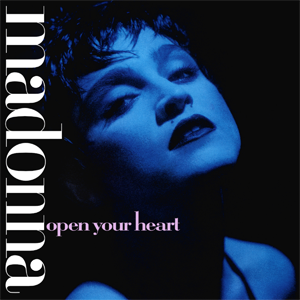
At a glance
“Open Your Heart” was written by Gardner Cole and Peter Rafelson as a rock song for Cyndi Lauper, who never heard it. It reached Madonna on a demo tape; she changed some of the words, and Patrick Leonard gave it a faster groove on a sequenced bass. It was the first song recorded for True Blue, in December 1985, and the album’s fourth single: No. 1 in the United States in February 1987 and No. 4 in Britain. Jean-Baptiste Mondino’s video, his first for her, is set in a peep show.
- No. 1
- US Hot 100, 7 February 1987
- No. 4
- UK
- 112
- beats per minute, in F major
- 10:35
- the extended version
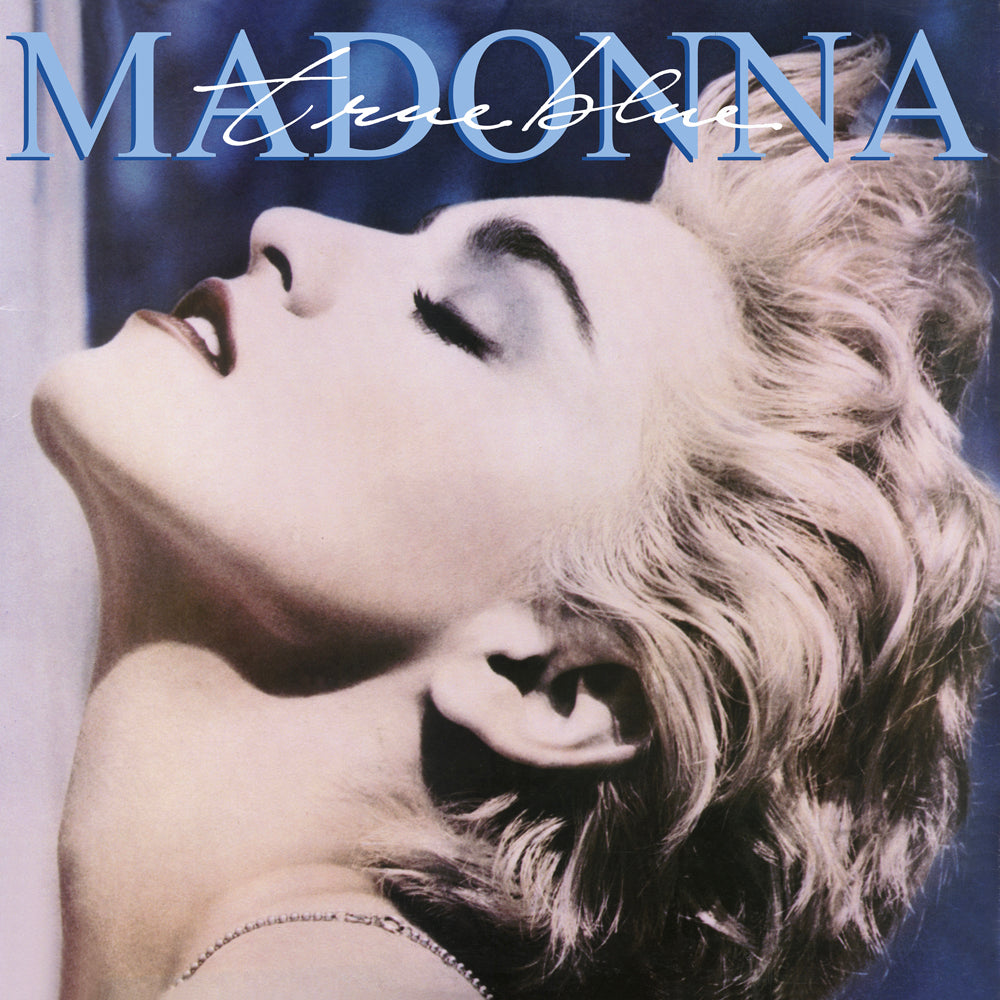
True Blue
1986
Official Video
Performing artists
Madonna
Lead Vocals, Background Vocals
Jonathan Moffett
Drums
David Williams
Guitar
Patrick Leonard
Keyboards
Paulinho da Costa
Percussion
Composition & lyrics
Songwriter
Songwriter
Songwriter
Production & engineering
Producer
Producer
Michael Verdick
Mixing Engineer, Engineer
Dan Nebenzal
Assistant Mixing Engineer
Ted Jensen
Mastering Engineer
Lyrics
I see you on the street and you walk on by
You make me wanna hang my head down and cry
If you gave me half a chance you'd see
My desire burning inside of me
But you choose to look the other way
I've had to work much harder than this
For something I want
Don't try to resist me
Open your heart to me, baby
I hold the lock and you hold the key
Open your heart to me, darlin'
I'll give you love if you, you turn the key
I think that you're afraid to look in my eyes
Oh baby
You look a little sad boy, I wonder why
I follow you around but you can't see
You're too wrapped up in yourself to notice
So you choose to look the other way
Well, I've got something to say
Don't try to run
I can keep up with you
Nothing can stop me from trying
You've got to
Open your heart to me, baby
I hold the lock and you hold the key
Open your heart to me, darlin'
I'll give you love if you, you turn the key
Open your heart with the key
One is such a lonely number
Aah, aah, aah, aah
Open your heart
I'll make you love me
It's not that hard
If you just turn the key (watch out)
Don't try to run
I can keep up with you
Nothing can stop me from trying
You've got to
Open your heart to me, baby
I hold the lock and you hold the key
Open your heart to me, darlin'
I'll give you love if you, you turn the key
Open your heart with the key
Open your heart
I'll make you love me (come on baby)
It's not that hard
If you just turn the key (I'm gonna get to you)
Open your heart
I'll make you love me (come on baby)
It's not that hard
If you just turn the key (watch out, watch out, watch out)
Open your heart
I'll make you love me (come on baby)
It's not that hard
If you just turn the key (watch out, watch out, watch out)
Open your heart
I'll make you love me (I'm gonna get to you)
It's not that hard
If you just turn the key (come on baby)
Madonna
- Album
- True Blue, 30 June 1986
- Single
- 12 November 1986 in the United States
- Written by
- Madonna, Gardner Cole, Peter Rafelson
- Produced by
- Madonna, Patrick Leonard
- Recorded
- from December 1985
- Engineered and mixed by
- Michael Verdick
- Length
- 4:12
- Genre
- Dance-pop, synth-pop, pop rock
- US Hot 100
- No. 1
- UK
- No. 4
The song
“Open Your Heart” is driving dance-pop: drums, percussion, guitar and keyboards on a sequenced bass that never lets go, with big keyboard hooks and Madonna’s own voices behind her. The words are a plea to someone who will not let her in. It is one of the first things she made with Patrick Leonard, the partner of Like a Prayer.
Two writers, two stories
Gardner Cole and Peter Rafelson worked on the song for about a year, far longer than the day or two a song usually took them, as Cole told Fred Bronson for The Billboard Book of Number One Hits. Their accounts of how it began do not agree.
Cole has said that its first title was “Follow Your Heart”, the name of a vegetarian restaurant in Los Angeles, and that the words were about a waitress there called Lisa.
Rafelson, the son of the film director Bob Rafelson, gave his version to DrownedMadonna in 2005.
“Open Your Heart” was the name from the beginning. I tend to write the title of a song early in the process.
I wrote the lyric about a beautiful girlfriend who did not speak much English. The power to communicate Heart to Heart was how we fell in love.
For Cyndi Lauper
Both agree on the singer they had in mind. “I was a fan and wanted to write for her,” Rafelson said of Cyndi Lauper. “Gardner Cole said he had access to Cyndi. I thought it would be wise to let him help. We spent a whole year to record the demo and when it was done, he never got it to her.” Cole confirmed to Bronson that Lauper never heard it. The song was then closer to rock.
Cole also told Bronson that Benny Medina, then at Motown, asked Rafelson for the song for the Temptations and put it on hold; when it turned out that Madonna had recorded it, that plan was given up.
The demos
Cole named Jason Scheff, later the singer and bass player of Chicago, as the voice of the first demo. Rafelson has a demo with his own voice singing the original words. When Madonna’s managers asked for the song sung by a woman, Cole turned to his girlfriend, Donna De Lory, and it was her demo that Madonna heard. De Lory is not on the record. Cole later recommended her to Patrick Leonard, who was putting together Madonna’s touring band, and she joined Madonna on stage in 1987 and stayed for years.
How it reached Madonna
Cole’s manager, Bennett Freed, was connected to Weisner-DeMann, the company that managed Madonna. Cole recalled that the song was played in their offices on Sunset Boulevard, that Freddy DeMann overheard it and thought of Madonna, and that the demo with a woman’s voice followed.
Rafelson told DrownedMadonna how the song came to be on the tape at all.
Gardner said he was going to submit a demo without “Open Your Heart” to Madonna. I broke into his studio one night and secretly recorded our song on his tape. She heard it and picked “Open Your Heart”!!
He had not added the title to the label of the tape, and his name was not on it. Nobody called him. He learned that Madonna had recorded his song when a friend who had been to her studio played him a rough mix, and he kept quiet about it: “In this business, nothing is final till it’s on vinyl.”
What Madonna and Patrick Leonard changed
Madonna rewrote parts of the verses and of the section before the chorus, Cole said, and she shares the writing credit. “Between Gardner and Madonna, it did not change drastically,” Rafelson told DrownedMadonna, “but they both did a great job to make it a better song.”
The music changed more. “Patrick Leonard changed the groove and made it more uptempo,” Cole said; to Bronson he added that Madonna and Leonard put a strong bass line under the song and turned its rock rhythm into dance. Rafelson’s verdict on the record: “It is no less than perfect!”
It was the first song recorded for True Blue, in December 1985, and Cole was afraid for months that it would not survive to the finished album.
Who plays
| Who | What |
|---|---|
| Madonna | Lead and backing vocals, producer |
| Patrick Leonard | Keyboards, producer |
| Jonathan Moffett | Drums |
| Paulinho da Costa | Percussion |
| David Williams | Guitar |
| Michael Verdick | Recording and mix |
| Dan Nebenzal | Mix assistant |
- 01
Madonna
- What
- Lead and backing vocals, producer
- 02
Patrick Leonard
- What
- Keyboards, producer
- 03
Jonathan Moffett
- What
- Drums
- 04
Paulinho da Costa
- What
- Percussion
- 05
David Williams
- What
- Guitar
- 06
Michael Verdick
- What
- Recording and mix
- 07
Dan Nebenzal
- What
- Mix assistant
Source: the sleeve of True Blue, 1986.
The bass is a sequence programmed by Leonard. The drums are played: the sleeve, which lists drum programming on other songs of the album, credits Jonathan Moffett here. Paulinho da Costa, the Brazilian percussionist, adds the syncopation around the beat, and David Williams the short funk guitar. Madonna is the only backing singer named.
How it is built
The published sheet music gives F major, 4/4 and about 112 beats per minute, marked “medium funk”. The harmony leans on an E-flat chord that does not belong to F major, the flattened seventh of rock, blues and funk. The record goes straight to its rhythm, on bright keyboard figures, with Madonna whispering “Watch out!” at the start. She sings the verses close and uncertain and the chorus bright and insistent.
Billboard, reviewing the single in 1986, wrote of a disco rhythm and “tinkly synths”, and heard a return to the dance-pop of her first hits after “Live to Tell” and “Papa Don’t Preach”. Tom Breihan, in Stereogum in 2021, heard the syncopations of Latin freestyle.
The ten-minute version
| Version | Length | What it is |
|---|---|---|
| Album version | 4:12 | The Madonna and Patrick Leonard production |
| Extended Version | 10:35 | Remix and additional production by Steve Thompson and Michael Barbiero |
| Dub Version | 6:40 | Their mix with the instruments in front |
| Remix/Edit | 3:59 | The short remix |
- 01
Album version
- Length
- 4:12
- What it is
- The Madonna and Patrick Leonard production
- 02
Extended Version
- Length
- 10:35
- What it is
- Remix and additional production by Steve Thompson and Michael Barbiero
- 03
Dub Version
- Length
- 6:40
- What it is
- Their mix with the instruments in front
- 04
Remix/Edit
- Length
- 3:59
- What it is
- The short remix
Reanna Cruz of NPR chose the Extended Version in July 2021, for the album’s thirty-fifth anniversary: it gives the instruments room, and about seven minutes in almost everything falls away and leaves the voice alone. The remixes were made available again with the digital anniversary edition of the album.
The video
The video was the first that the French photographer Jean-Baptiste Mondino directed for Madonna. Rafelson told DrownedMadonna that he had a part in the meeting: he was at Hugo’s on the night he introduced himself to the producer David Naylor and the model Janice Dickinson; Mondino was there, they all sat down together, and the video was the first work of Mondino and Naylor together.
The peep show was Mondino’s idea, he told Rolling Stone and Numéro. Madonna dances on a chair for people watching from booths; a boy, played by Felix Howard, waits outside because he is too young to go in; at the end she leaves in a man’s suit and hat and runs off with him. Mondino spoke of redemption and escape, and compared the ending to Charlie Chaplin’s. The dance comes from Bob Fosse and Cabaret, the faces and the artificial setting from Fellini, and the walls carry paintings by Tamara de Lempicka, among them Andromeda (1929).
Mondino had wanted Madonna in a black wig, away from her short blonde hair. In the dressing room she asked what he thought; he answered that the wig was good and that he liked her better blonde, and from that moment, he said, she trusted him. In the video she takes the wig off.
| Who | What |
|---|---|
| Jean-Baptiste Mondino | Director |
| David Naylor, Sharon Oreck | Producers |
| Pascal Lebègue | Director of photography |
| Richard Sylbert | Production design |
| Michael Z. Hanan | Art direction |
| Mitchell Sinoway | Editing |
| Marlene Stewart | Costumes |
| Brad Jeffries | Choreography |
- 01
Jean-Baptiste Mondino
- What
- Director
- 02
David Naylor, Sharon Oreck
- What
- Producers
- 03
Pascal Lebègue
- What
- Director of photography
- 04
Richard Sylbert
- What
- Production design
- 05
Michael Z. Hanan
- What
- Art direction
- 06
Mitchell Sinoway
- What
- Editing
- 07
Marlene Stewart
- What
- Costumes
- 08
Brad Jeffries
- What
- Choreography
A study in the Journal of Communication in 1990 showed the video to older adolescents and found that they did not see the same thing: some of the girls who were fans of Madonna found the peep show degrading and read the ending as an escape from the men’s eyes, others saw above all the pleasure of the dance.
Charts
“Open Your Heart” reached No. 1 on the Billboard Hot 100 on 7 February 1987, for one week: the third No. 1 from True Blue, after “Live to Tell” and “Papa Don’t Preach”, and the first for Rafelson as a writer. In the United Kingdom it reached No. 4 at the end of December 1986, with about 170,000 copies sold in 1986 and 40,000 more in 1987.
Afterwards
Madonna opened the Who’s That Girl Tour of 1987 with it, in the costume and the moves of the video, and sang it after “Express Yourself” at the start of the Blond Ambition Tour in 1990. Its introduction returned as a short interlude on the Drowned World Tour in 2001, and the whole song, rearranged, on The MDNA Tour in 2012.
Rafelson told DrownedMadonna that the Israeli singer Ofra Haza recorded a version he loves, that Britney Spears sings the song in her film Crossroads and calls it her favourite, and that some of its words return in “Frozen”: Madonna, he said, named “Open Your Heart” as an inspiration for the song with the line “I hold the key”.
The interview
Inside the song
The sound
- Machine
Has sequenced bass.
Classic Pop, Classic Album: True Blue (2025)
Its place
Was first written for Cyndi Lauper.
Wikipedia, True Blue (Madonna album)