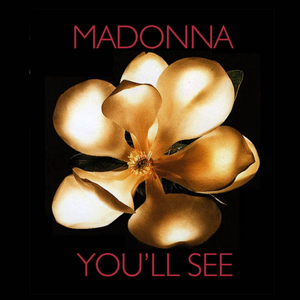
At a glance
“Verás” is “You’ll See” sung entirely in Spanish. The words are by the Argentine songwriter Paz Martínez, who was asked for them on Madonna’s behalf and never met her; she recorded them at Crescent Moon Studios in Miami with David Foster. Two more versions mix the languages, one with English verses and a Spanish chorus, the other the reverse. The song was No. 1 on Spanish radio, and its video won two awards at MTV Latino in 1996.
- 1995
- released
- 4:21
- length
- No. 1
- Spanish radio airplay
- 2
- MTV Latino awards, 1996
Performing artists
Madonna
Vocals
David Foster
Keyboards
Dean Parks
Acoustic Guitar
Michael Thompson
Electric Guitar
Simon Franglen
Synclavier Programming
Composition & lyrics
Songwriter, Arranger
Arranger, Songwriter
Spanish Lyrics
Production & engineering
Producer
Producer
David Reitzas
Recording Engineer, Mixing Engineer
Felipe Elgueta
Assistant Engineer
Ronnie Rivera
Assistant Engineer
Sean Chambers
Assistant Engineer
“Verás”
- Original song
- “You’ll See”, by Madonna and David Foster
- Spanish words
- Paz Martínez
- Produced by
- Madonna, David Foster
- Recorded
- Crescent Moon Studios, Miami, 1995
- Length
- 4:21
- Kind
- Pop ballad with Latin colour, adult contemporary
- Labels
- Maverick, Sire, Warner Bros.
Three versions in Spanish
There are three Spanish-language versions of “You’ll See”, the ballad of 1995.
The three versions
| Recording | Language | Length |
|---|---|---|
| “Verás” (Spanish Version) | Spanish throughout | 4:21 |
| Spanglish Version #1 | English verses, Spanish chorus | 4:19–4:20 |
| Spanglish Version #2 | Spanish verses, English chorus | 4:19–4:20 |
The two Spanglish versions are edits of the English and Spanish performances, and not separate songs. Older releases and collectors’ lists name them inconsistently. They have a page of their own.
How “Verás” came about
In September 1995 Madonna worked with the Canadian songwriter and producer David Foster on new material for Something to Remember, the album of her ballads. “You’ll See” and “One More Chance” are the two songs they wrote for it. “You’ll See” came out as a single on 30 October 1995 and reached No. 6 on the Billboard Hot 100 and No. 5 in the United Kingdom. The Spanish adaptation followed shortly afterwards.
Paz Martínez. Born Norberto Alfredo Gurvich, Martínez was an established Argentine singer and songwriter, with long experience of writing romantic ballads and adapting songs for other artists. In an interview with Infobae, published on 5 April 2026, he recalled that he was in Mexico in 1995 when a friend told him that Madonna had recorded English-language ballads with David Foster and wanted one of them in Spanish.
One of these, she wants to record it in Spanish, for the market.
He was asked whether he would write the Spanish words, and accepted.
Who asked for it. The Argentine press has said for more than twenty years that the request came from Madonna herself. Clarín, in a feature of 2002, wrote that “Madonna herself” called on him to write a version in Spanish. An interview of 7 November 2004, from the news agency Télam, has Martínez remembering that Madonna asked him for it. Diario Río Negro, interviewing him on 10 October 2021, says that the adaptation was made at Madonna’s own request.
Martínez himself describes the route the request took. In an interview published by Villa María VIVO! on 6 November 2025 he said that such jobs almost always reach him because a record company calls him in, and that this was the case with Madonna. In Ámbito of 23 November 2007, asked by Leandro Ferreyra whether he had met her, he answered:
Unfortunately I never met her, because we always communicated through a friend who has a record company.
He was told that Madonna liked his work, and he first heard her recording over the telephone.
An adaptation, not a translation. Martínez draws a line between translating a song and adapting it.
When I write versions, let’s be clear, they are not translations.
Spanish, he explains, generally needs more syllables than English to say the same thing, so a literal translation is hard to sing over an unchanged melody. His method was to keep the intention of the song and choose Spanish words that fit its metre, its melodic phrasing and its emotional course. He has the writing credit for the Spanish words.
The title keeps the force of the original. “You’ll see” tells a former lover that the singer will manage without him; “verás” says the same.
The Miami session
The Spanish vocal was recorded at Crescent Moon Studios in Miami, the studio of Gloria and Emilio Estefan. The English “You’ll See” had been recorded at Chartmaker Studios and Brooklyn Studios.
Billboard of 10 February 1996 reported that Madonna recorded and mixed her Spanish version at Crescent Moon, with David Foster producing, David Reitzas engineering and Sean Chambers assisting. Emilio Estefan was present; neither he nor Gloria Estefan has a credit on the recording.
David Foster’s memories. Foster wrote about working with Madonna in his autobiography, Hitman: Forty Years Making Music, Topping the Charts & Winning Grammys (2008). He remembered her as punctual, hard-working and really involved in producing the material, unlike artists who take a production credit without contributing much.
He also told a story from the Miami session. Madonna suddenly stopped singing, and Foster went to see what had happened. He found her lying on her back on the studio floor, in a relaxed, almost meditative position.
The engineer David Reitzas, in an interview of 1999, described making a hospital-like setting so that Madonna could record a passage of Evita lying down. That was another session.
Her Spanish. Paz Martínez has praised her delivery more than once. In September 2023 he told Cadena 3 Argentina:
Madonna doesn’t speak a word of Spanish, and she did it perfectly.
He said much the same to Radio Provincia in 2024 and to Infobae in April 2026. This is his own judgment of her pronunciation.
Who made it
Songwriting and production credits
| Role | Person |
|---|---|
| Lead vocals | Madonna |
| Original composition | Madonna, David Foster |
| Spanish-language adaptation | Paz Martínez |
| Producers | Madonna, David Foster |
| Arrangers | Madonna, David Foster |
| Keyboards | David Foster |
| Acoustic guitar | Dean Parks |
| Electric guitar | Michael Thompson |
| Synclavier programming | Simon Franglen |
| Recording and mixing engineer | David Reitzas |
| Assistant engineering and mixing | Felipe Elgueta, Ronnie Rivera |
| Assistant at the Miami session | Sean Chambers |
Source: the US maxi-single of 1995, catalogue number 9 43649-2, which credits the players, the programmer and the engineers for both the English and the Spanish version; Madonna’s official discography.
- Dean Parks plays the acoustic guitar at the centre of the song: arpeggios and plucked phrases that set a restrained rhythmic and harmonic base.
- Michael Thompson is credited with the electric guitar. The track has sustained, tremolo-like guitar textures.
- Simon Franglen did the Synclavier programming, the digital part of the production.
- David Reitzas recorded and mixed it. He worked regularly with Foster.
The music
“Verás” has the music of “You’ll See”: a controlled acoustic pop ballad with a Spanish guitar colour, electronic accompaniment and the voice in front.
The song is in E minor. The verse begins on a recurring movement from E minor to D, restrained at first and more dramatic as it goes on. There is no Latin dance rhythm in it: the Latin character comes from the sound of the guitar, the phrasing and, here, the language.
Instruments and sounds
| Instrument or sound | What it does |
|---|---|
| Acoustic guitar | Plucked, Spanish-style arpeggios and melodic figures |
| Electric guitar | Expressive accents, sustained textures, further melodic colour |
| Keyboards, piano-like sounds | The harmonic base under the voice |
| Electronic bass tones | Restrained support in the low register |
| Synclavier sounds | Digital textures and programmed elements |
| Percussion | Rhythm added gradually as the song develops |
| Chime-like accents | Bright ornaments in the arrangement |
| Synthesized atmospheric layers | Sustained textures in the background |
| Lead vocal | From controlled, intimate phrases to stronger declarations |
| Reverb and studio ambience | Space around a fairly exposed voice |
The credits name acoustic guitar, electric guitar, keyboards and Synclavier programming. Bass, chimes and atmospheric layers describe what is heard in the finished arrangement; no players or hardware are credited for them.
The Synclavier. The Synclavier was a professional digital system that joined synthesis, sampling and computer-controlled sequencing. It could produce sampled instruments and complex digital timbres in exact time, to be combined with recorded instruments. Simon Franglen is credited with Synclavier programming on “You’ll See”, and the documentation of the Spanish version repeats the credit.
The arrangement. Foster does not cover the recording with a large orchestra. It rests on the articulation of the guitar, on spacious electronic textures and on the placing of Madonna’s voice. It grows gradually: the intimate opening gains rhythm and instrumental density, so that the last sections are more forceful and still led by the guitar. The record sits between adult contemporary pop, soft rock and a ballad with a Latin tinge.
Toni Braxton. “You’ll See” has a documented kinship of style with “Un-Break My Heart” (1996), which David Foster also produced. Writing in Stereogum, Tom Breihan notes Foster’s use of Spanish-style guitar in both. Foster named Bryan Adams’s “Have You Ever Really Loved a Woman?” as an influence on the guitar of “Un-Break My Heart”. The link is one of style and instruments.
The releases, 1995–1996
Where “Verás” was released
- United States, 1995: “You’ll See” maxi-single
- Maverick / Warner Bros. 9 43649-2. The English version, the instrumental, the complete Spanish version and a live recording of “Live to Tell”.
- United States, 1995: promotional CD
- PRO-CD-8040-R. The Spanish-language versions, both numbered Spanglish edits included.
- Mexico: promotional CD
- Warner PCD 954, a promotional CD of “Verás”.
- United Kingdom, 1996: “One More Chance” CD
- W0337CD / W0337CDX. “One More Chance”, “You’ll See (Spanish Version)” and “You’ll See (Spanglish Version)”.
- Germany, Australia and Japan, 1996
- German CD 9362-4377-2 and Australian CD 9362436772, with the Spanish recording and Spanglish Version #1. Japanese CD WPCR-572.
- Selected editions of Something to Remember
- With “Verás” as an added track.
Why the titles are confusing. The promotional material of 1995 used overlapping names: “Spanish Version”, “Spanglish Version”, “Spanish Version with English”, and numbered variants. Later pressings simplified some of them and gave others local names. On the Japanese “One More Chance” CD the Spanglish recording is printed as “Spanish Version #1”. The printed title of a disc does not always say which performance is on it.
The date of the single. Sources differ on “You’ll See”: Madonna’s official discography shows 13 October 1995, and several detailed discographies give 30 October 1995 for the commercial single.
The digital reissue of 2023. You’ll See (The Remixes), released digitally on 23 October 2023, has the full Spanish recording and both Spanglish edits.
You’ll See (The Remixes), 2023
| Track | Length |
|---|---|
| You’ll See | 4:38 |
| You’ll See (Spanglish Version) | 4:19 |
| You’ll See (Spanglish Version #2) | 4:19 |
| You’ll See (Spanish Version) | 4:21 |
| You’ll See (Edit) | 4:16 |
| You’ll See (Instrumental) | 4:42 |
| Live to Tell (Live) | 8:14 |
In spite of its title the EP has no new dance remixes: it gathers the recordings, language edits, instrumental and short versions of 1995.
The video
“Verás” has an official video, made partly from that of “You’ll See”.
The video of “You’ll See” was directed by Michael Haussman and continues the story of his video for “Take a Bow” (1994). The Spanish bullfighter Emilio Muñoz returns in his role. “Take a Bow” shows the troubled relationship; in “You’ll See” Madonna’s character leaves him. Madonna’s official discography calls it a sequel.
The Spanish video joins that material to new footage of Madonna singing in a recording studio. The viewer sees the story with Muñoz and, beside it, Madonna at the microphone delivering the Spanish vocal.
The direction is credited to Michael Haussman, and the photography of the original material to Adrian Wilde.
Two awards at MTV Latino. The Argentine newspaper La Nación reported on 28 August 1996 that the video of “Verás” had won two awards at MTV’s Latin American video awards: Best Female Performance in a Video and Best Cinematography. The report names the song by its Spanish title.
The English video of “You’ll See” was nominated for Best Cinematography at the 1996 MTV Video Music Awards and did not win. That is another ceremony.
On the radio and the charts
In Spanish
- Spanish radio airplay
- No. 1
- US Latin Pop Airplay
- No. 10
- US Hot Latin Tracks
- No. 21
Sources: Music & Media, 17 February 1996; Billboard.
Music & Media of 17 February 1996 has “MADONNA / YOU’LL SEE / VERÁS” at No. 1 in its Spanish airplay listing: the entry counts the song under both titles together.
In the United States the Spanish-language campaign reached No. 10 on Billboard’s Latin Pop Airplay chart on 6 January 1996 and No. 21 on Hot Latin Tracks on 20 January.
On stage, and her other songs in Spanish
Madonna sang “You’ll See” in English on the British television programme Top of the Pops on 2 November 1995, and at some American concerts of the Drowned World Tour in 2001, in place of “Gone”.
Earlier songs, such as “La Isla Bonita”, “Who’s That Girl” and “Spanish Eyes”, have Spanish words or images inside English lyrics. “Verás” is the first time she recorded a whole existing English song in Spanish, with a professional lyricist.
Later came “Be Careful (Cuidado Con Mi Corazón)” with Ricky Martin, and “Lo Que Siente la Mujer”, the Spanish version of “What It Feels Like for a Girl”. “Lo Que Siente la Mujer” is its nearest relative: a Spanish version of a song first recorded in English.
Inside the song
The sound
- Production
Recorded and mixed at Crescent Moon Studios in Miami, with David Foster producing and David Reitzas engineering.
Billboard (10 February 1996)
- Instrument
Acoustic guitar by Dean Parks, electric guitar by Michael Thompson, keyboards by David Foster.
“You’ll See” maxi-single (1995)
- Machine
Synclavier programming by Simon Franglen.
“You’ll See” maxi-single (1995)
- Voice
Sung entirely in Spanish. “Madonna doesn’t speak a word of Spanish, and she did it perfectly,” said Paz Martínez.
Paz Martínez, Cadena 3 Argentina (September 2023)
Style
- Genre
A ballad in E minor led by Spanish-style acoustic guitar, with no Latin dance rhythm. |
Who made it
The song is by Madonna and David Foster; Paz Martínez is credited for the Spanish words.
“You’ll See” maxi-single (1995)
Produced and arranged by Madonna and David Foster.
“You’ll See” maxi-single (1995)
The words
The Spanish words are by the Argentine songwriter Paz Martínez: an adaptation that keeps the sense and fits the melody, not a literal translation.
Paz Martínez
Its place
Martínez was in Mexico when the request reached him, through a friend with a record company; he never met Madonna and first heard her recording over the telephone.
Paz Martínez, Ámbito (23 November 2007)
Two further versions mix the languages: English verses with a Spanish chorus, and Spanish verses with an English chorus. |
No. 1 on Spanish radio in February 1996, and No. 10 on Billboard’s Latin Pop Airplay chart.
Music & Media (17 February 1996); Billboard
Its video, with added footage of Madonna singing in a studio, won two awards at MTV Latino in 1996.
La Nación (28 August 1996)
Released As B-side
Last updated