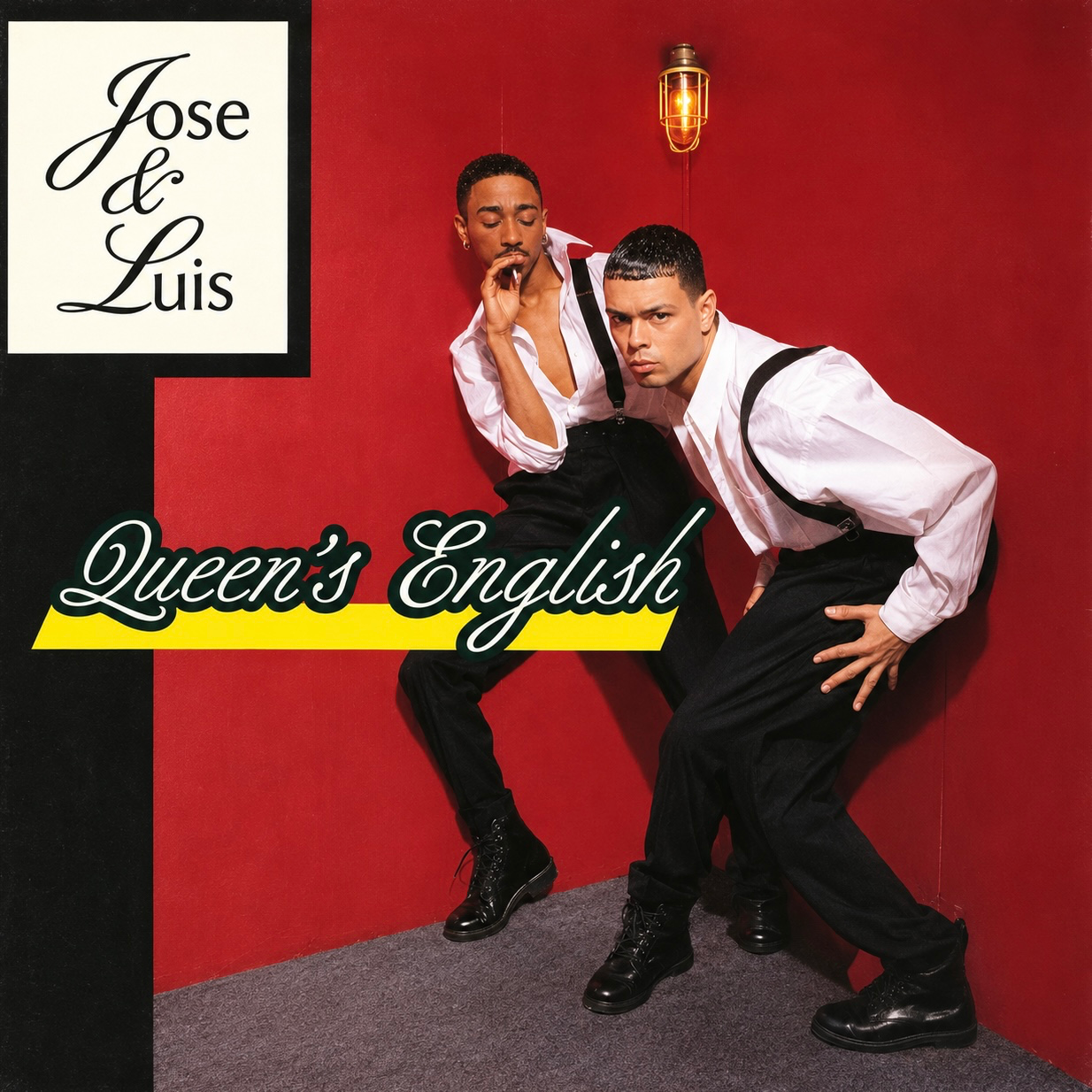
Tracklist
Queen’s English (Album Version)
Queen’s English (Royal Club Mix)
Queen’s English (The Factory Mix)
Queen’s English (The Queen’s Spanish)
Queen’s English (Mo Mo’s In The House)
Queen’s English (Royal Dub)
At a glance
“Queen’s English” is the 1993 single by José Gutierez and Luis Camacho, the House of Xtravaganza dancers of “Vogue” and the Blond Ambition World Tour. Madonna sings its recurring hook, and in April 1992 Billboard reported her at Platinum Island Studios in New York with Junior Vasquez, “producing and mixing” the track for the first act signed to her new label. It came out on Sire, not Maverick.
- April 1992
- Billboard reports her producing and mixing it
- 6
- versions on the US maxi-CD
- 14:17
- The Factory Mix, the longest
- 4
- writers, Madonna not among them
This video is hosted on YouTube (Google)
If you click “Accept and play”, it loads from YouTube (Google), which may collect data about you (such as your IP address) and set cookies. Privacy Policy
Performing artists
José Gutierez
Vocals
Luis Camacho
Vocals
Madonna
Backing Vocals
Sheila Brody
Backing Vocals
Merv de Peyer
Keyboards, Programming
Composition & lyrics
Songwriter
Songwriter
Songwriter
Songwriter
Production & engineering
Producer
Dennis Mitchell
Recording Engineer
John Wall
Assistant Engineer
Len Prince
Cover Photography
Dirk Walter
Design
José and Luis, from “Vogue” to a record of their own
José Gutierez and Luis Camacho were dancers of the House of Xtravaganza, the New York ballroom house, when Madonna chose them for “Vogue” in 1990. In Vogue’s 2023 oral history of ballroom culture, José recalled that she asked them both to take part in the video and to choreograph it. They went on to the Blond Ambition World Tour, the 1990 MTV Video Music Awards, the Rock the Vote campaign and Truth or Dare.
Madonna spoke about them in her May 1991 interview with The Advocate: “When I saw Jose and Luis dancing, I was completely blown away by them.” A year later the roles were reversed: José and Luis were the recording artists, and Madonna sang behind them.
Madonna in the studio, April 1992
In its Audio Track column of 25 April 1992 (page 60), Billboard reported Madonna and Junior Vasquez at work at Platinum Island Studios in New York. The report named Dennis Mitchell as engineer and John Wall as assistant.
Producing and mixing ‘The Queens’ English’ for Jose And Luis, the first signing to Madonna’s new label.
The released record credits Junior Vasquez alone as producer. Madonna’s presence at the production and mixing sessions is documented by Billboard; a formal production credit for her is not.
“Yeah, I sing backup”
Madonna talked about the song on MTV in Milan in the autumn of 1992, while promoting Erotica and Sex, in an interview with Steve Blame. One record of the interview dates it 6 October 1992, another November 1992. She said the song would appear on a compilation of New York house artists and that the project belonged to her new label, Maverick. Asked whether she sang on it, she answered:
Yeah, I sing backup. Yeah!
The hook and the language of the balls
The song began with the private language José and Luis used between themselves, which Luis Camacho called “gay pig latin” in a 2005 interview. They turned their coded expressions and jokes into a dance record. “Madonna liked the idea and said she was down to sing the hook,” Camacho said.
Her line is “Queens that read are the best.” Reading, in the ballroom sense, is exposing someone’s faults with wit; Camacho explained that he and José considered themselves especially good at reading other queens in their own language. The title turns “the Queen’s English”, the standard British English of the monarchy, into the speech of New York’s ballroom scene, the world shown in Paris Is Burning (1990).
The record belongs to the New York house of the Sound Factory years. Junior Vasquez had already drawn the House of Xtravaganza to the club with “Just Like a Queen”, his 1989 production as Ellis-D with Coko Xtravaganza, and he later told DJ Mag that the records known as “bitch tracks” grew out of the verbal sparring of the balls. He did not name “Queen’s English” among them.
Release: Sire, 1993
The single came out on Sire / Warner Bros., not on Maverick; why it moved has not been explained. The Los Angeles Times announced it on 25 April 1993, naming Madonna’s backing vocals. The US copyright registration of the song (PA0000669627, registered on 4 October 1993) gives 1 May 1993 as the date of publication of the six-track maxi-CD. Many discographies give September 1993, the month of the parent compilation.
That compilation was New Faces, published on 14 September 1993 (Sire 9 45320-2). Sire’s president Seymour Stein conceived it in place of four separate debut albums: three songs each by four new dance acts, Doubleplusgood, Subliminal NY, La Casa and José & Luis. “Queen’s English” is track 12, after “Do It to the Rhythm” and “You Want to Touch Me”, written by the same four writers. Months earlier the song had been track 13 of Boys United (PRO-CD-6101), a Sire promotional CD offered to readers of the gay magazine Genre, as “The Queen’s English (J&L 7”)”, 4:18.
The 1993 US editions
| Edition | Catalogue number | Versions |
|---|---|---|
| Maxi-CD, Eco-pak sleeve | 9 40543-2 | 6 |
| 12-inch | 9 40543-0 | 6, in a different order |
| Promotional CD | PRO-CD-6478 | 4, with the Mo Mo & The Boys Single Mix |
| Promotional cassette | PRO-C-6478 | 3, with The Queen’s Spanish |
| Boys United, promotional CD for Genre readers | PRO-CD-6101 | 1, “The Queen’s English (J&L 7”)” |
| New Faces, compilation | 9 45320-2 | 1, track 12 |
| Hot Tracks 12-7, DJ service | – | 1, Ron Hester’s Hot Tracks Digital Remix |
Source: the release listings and the US copyright registrations.
The Factory Mix, at 14:17, is the longest: a club-length version of the kind Vasquez played as resident DJ at the Sound Factory. Some older discographies describe Mo Mo’s In The House as the mix in which Madonna’s voice leads rather than sits in the background; nobody involved in the record has confirmed it.
The credits
The song was written by José Gutierez, Luis Camacho, Junior Vasquez and Merv de Peyer, the four names in the copyright registration; Madonna is not among them. De Peyer, whose credits include Miles Davis, New Order and Cyndi Lauper, also played the keyboards and did the programming, and his own discography lists the record as José & Luis feat. Madonna.
The other backing vocalist was Sheila Brody, a singer from George Clinton’s Brides of Funkenstein who later recorded as Amuka and Blackwood, and went on working with Vasquez into the 2000s. How the backing vocals were shared between her and Madonna is not documented.
Dennis Mitchell, the engineer of the session, later worked with Madonna and Vasquez again, on the remixes of “Secret” in 1994 and on “Bedtime Story” in 1995. The cover photograph is by Len Prince; the sleeve was designed by Dirk Walter, who also designed the sleeve of “I’ll Remember” in 1994.
The video
The video plays on the title with camp, dancing and a drag impersonator of Queen Elizabeth II, who mouths Madonna’s lines. Madonna does not appear in it. Billboard reported that it was shown on MTV Latino, in the same campaign towards Spanish-speaking audiences that produced The Queen’s Spanish version. It was distributed to clubs on the Rock America dance video compilation in November 1993. Its director has not been identified.
Reception
Larry Flick reviewed New Faces in his Dance Trax column in Billboard on 16 October 1993, praised the humour of “Queen’s English”, noted Madonna’s voice and reported that the single was “fast becoming a club smash.” He was less sure of the duo’s other two songs. No chart position for the single has been documented.
On the radio, the University of Houston’s archive of KPFT’s LGBTQ programmes holds a broadcast of 10 July 1993 in which the presenters played the song from Boys United and named Madonna’s part, and another of 20 August 1994, where it was played on a listener’s request. A regular of the Sound Factory recalled in 2024 that Vasquez played the record several times there, though it never became as central to his sets as “X”, his later tribute to the House of Xtravaganza.
In 2018, 25 years on, Luis Camacho told the Bay Area Reporter that the record was one of the highlights of his career. The same year Vanity Fair España closed its history of voguing with it: “En 1993 hizo los coros en el debut discográfico de Jose & Luis, Queen’s English, y adiós.”
Timeline
1989
Junior Vasquez, as Ellis-D, releases “Just Like a Queen” with Coko Xtravaganza.
1990
José and Luis dance in “Vogue” and on the Blond Ambition World Tour.
25 April 1992
Billboard reports Madonna and Vasquez producing and mixing the song at Platinum Island.
Autumn 1992
Madonna tells MTV in Milan that she sings backup on it.
25 April 1993
The Los Angeles Times announces the record and Madonna’s vocals.
1 May 1993
Date of publication of the maxi-CD in the US copyright registration.
10 July 1993
KPFT Houston plays it from Boys United.
14 September 1993
New Faces is published.
16 October 1993
Larry Flick in Billboard: “fast becoming a club smash.”
November 1993
The video goes to clubs on Rock America.
2018
Luis Camacho calls it one of the highlights of his career.
What is still open
What Madonna actually did at the production and mixing sessions has not been described by anyone who was there, and nothing shows that she sang on the duo’s other two songs. A tape of a Junior Vasquez set at the Sound Factory, dated 5 January 1992, lists “Queens English (unreleased dub?)”: if the date and the identification are right, the song existed three months before the Billboard report. A Madonna-only version circulating among collectors, and the description of the song as an Erotica outtake in some older discographies, have no support in the documents: from the first report in 1992 the song was a José & Luis project.
Last updated